The Sea of Sparrows and Stones
The Sea of Sparrows and Stones
Critical Thinking in the age of super abundance
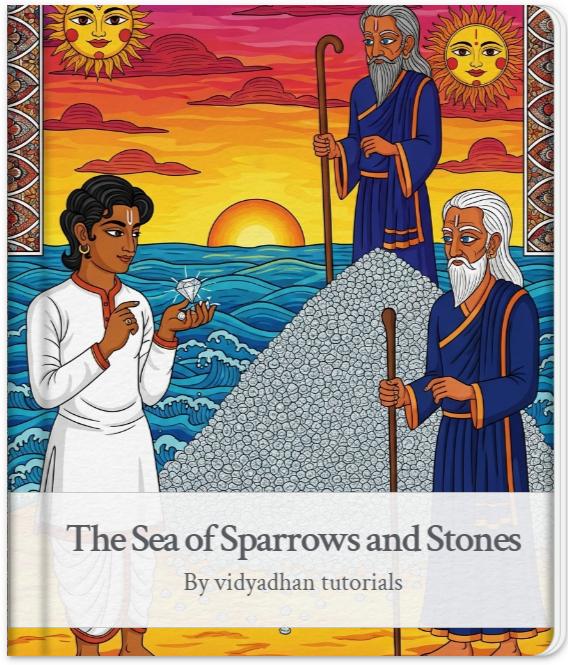
On the edge of the great Arabian Sea, where the waves whisper secrets to the salt-crusted sand, lived a young man named Advait. He was a collector of thoughts, but his mind felt like a dark room waiting for a single candle. He spent his days watching the tide, wondering why the world felt so vast yet so empty of the one truth he craved.
One evening, as the sun dipped like a molten coin into the water, Advait folded his hands. “O Great Spirit of the Deep,” he whispered, “I am tired of searching. Grant me just one diamond of pure knowledge. One single, perfect spark to light my way and tell me what is true.” He closed his eyes, hoping for a sign.
Suddenly, the air grew warm and smelled of sandalwood. Standing upon the foam was Rishi, a figure draped in robes that looked like the starry night. Rishi did not look like a king, but his eyes held the depth of a thousand libraries. He smiled at Advait, a smile that was both kind and a little mysterious.
“You ask for a single spark, Advait?” Rishi’s voice sounded like the ringing of a temple bell. “Why ask for a drop when the heavens are ready to pour? I shall give you what you seek, and more. I shall give you every answer that has ever been dreamt, every fact that has ever been found.”
With a snap of Rishi’s fingers, the sky did not rain water. It rained light. Millions of tiny, glittering diamonds began to fall from the clouds, bouncing off the sand and piling up around Advait’s feet. At first, he laughed, catching the gems in his palms, marveling at their brilliance. “It is a miracle!” he cried.
But the rain did not stop. The diamonds piled higher and higher, burying the shells and the sand. Soon, they were up to Advait’s knees, then his waist. Every gem looked exactly like the next. When he picked one up to read its secret, ten more fell upon his head, distracting him with their shine.
Rishi reached into his robes and pulled out a small, simple lens made of clear crystal. “Abundance is a storm, Advait. To survive it, you do not need more gems. You need the Sieve of Discernment.” Advait took the lens and looked through it. The zillion diamonds didn’t disappear, but through the glass, they began to reveal their true nature.
“Look closer, Advait,” Rishi said. “These diamonds are like ‘Data’—the fragments of facts that fill your modern world. When there is too much, it becomes ‘Information Overload.’ Like this shore, your mind becomes a cluttered room where you cannot find the door. This is the weight of having every answer but no direction.”
“But I wanted choices!” Advait cried. Rishi nodded slowly. “That is the ‘Paradox of Choice.’ When you have two gems, you pick the best. When you have a zillion, you are paralyzed by the fear of missing the right one. Artificial Intelligence can give you the world’s facts, but it cannot give you the ‘Wisdom’ to know which facts matter to your heart.”
Advait understood. He didn’t need to carry every diamond; he needed ‘Critical Thinking’ to be his sieve. He had to ask: ‘Is this true? Is this helpful?’ Like a master jeweler in a Jaipur bazaar, he must choose only the gems that have worth. He left the shore not with a mountain of stones, but with a clear mind and a single, purposeful spark.
The Philosophy of Data: Key Takeaways of The Sea of Sparrows and Stones
By Abhidnya Learning Spaces
This story beautifully illustrates a core challenge of the modern digital age: the tension between having access to everything and knowing what truly matters. In the pedagogical framework of Abhidnya Learning Spaces, where we focus on developing the “whole-brain learner” amidst a landscape of AI-driven information, this narrative serves as a vital reminder.
The Illusion of Abundance (Information Overload): In the digital era, data is often mistaken for knowledge. Just as the diamonds in the story were beautiful but suffocating, raw information without a filter leads to paralysis rather than enlightenment. The “Paradox of Choice” is real; when every fact is available, the human mind struggles to discern which facts are relevant to the growth of the soul and the cultivation of the intellect.
The Sieve of Critical Thinking: The “lens” Rishi gives Advait represents the cognitive process of Critical Thinking. It is not enough to possess data; one must actively filter it.
- The Filter: “Is this true?” (Verification)
- The Value: “Is this helpful?” (Utility)
- The Outcome: Wisdom (Application)
AI as a Tool, Not an Oracle: The story highlights the critical distinction between the capacity of Artificial Intelligence and the purpose of human wisdom. AI can generate a “zillion diamonds” (facts), but it cannot provide the meaning or the moral compass required to choose the right one. Wisdom is the human-centric ability to prioritize values over raw volume.
The Master Jeweler’s Mindset: For the learner, the goal of education is no longer to store the most “diamonds” (rote memorization), but to develop the sharpest “eye” (critical discernment). A true learner is not the one who carries the heaviest load of facts, but the one who has the clarity to identify the few stones that possess true worth.
The Abhidnya Perspective: Education is not about adding more; it is often about knowing what to subtract. By integrating Critical Thinking into our curriculum, we transition from being passive collectors of “thoughts” to purposeful architects of “wisdom.”